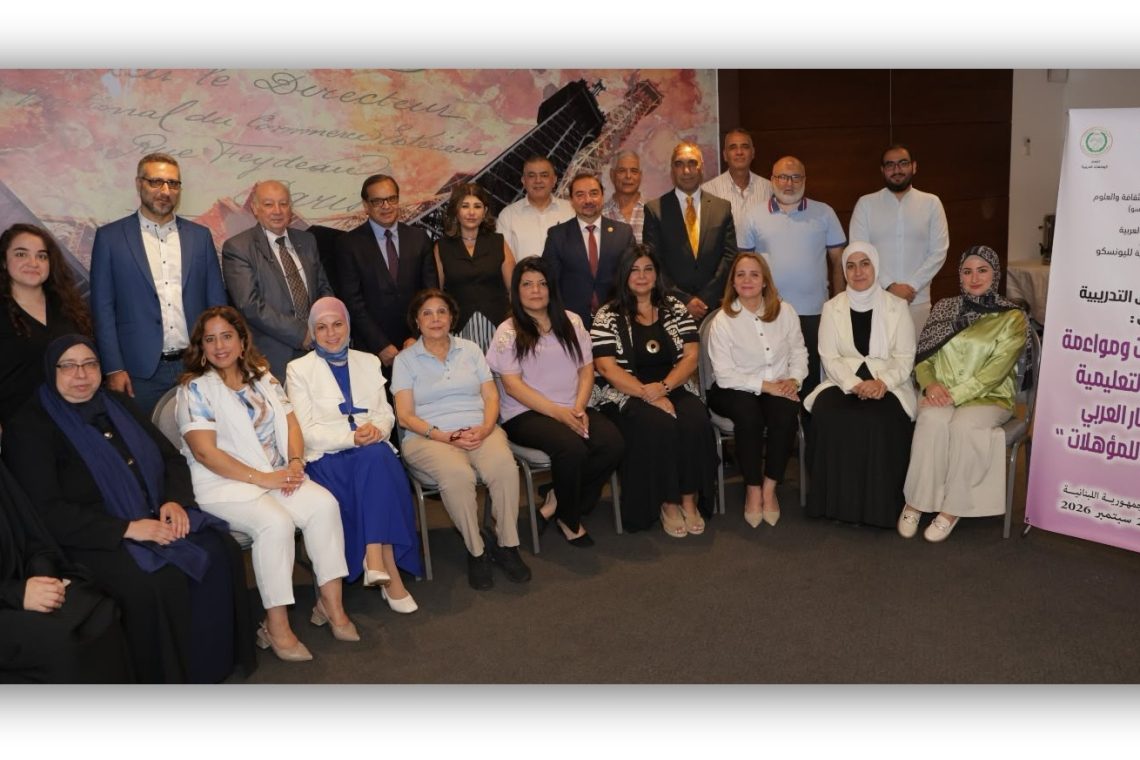
The capital city of Lebanon, Beirut, hosted a regional training workshop on “Enhancing the Quality of Educational Qualifications in Light of the Arab Common Qualifications Framework,” organized by ALECSO, represented by its Department of Education, in collaboration with the Lebanese National Commission for Education, Culture and Science, and in coordination with the Association of Arab Universities. The workshop was held from 21 to 23 September 2026, with the participation of prominent experts and specialists in education, qualifications, and quality assurance.
The workshop aims to support the implementation of the Arab Common Qualifications Framework and enhance the clarity, comparability, and recognition of qualifications in a way that keeps pace with the rapid transformations taking place in education and employment, while supporting lifelong learning and academic and professional mobility across the Arab world.
In his opening remarks, Dr. Rami Iskander, Director of Education, conveyed the greetings of H.E. Dr. Mohamed Ould Amar, Director-General of ALECSO, and his wishes for the success of the workshop. He highlighted the importance of qualifications, which are closely linked to the core of education policy and the future of Arab human capital. He stressed that the key challenge is to build confidence in what people learn and in what they are capable of achieving.
He noted that the Arab Common Qualifications Framework provides a shared language for understanding qualification levels and learning outcomes, thereby enhancing transparency, comparability, and recognition while preserving the specificities of national education systems. He further stated that the quality of a qualification begins with the design of learning outcomes and educational programs, proceeds through reliable assessment and quality assurance, and ultimately depends on learners’ ability to apply what they have acquired in education and employment.
Dr. Iskander emphasized that the success of the Framework should not be measured by its adoption as a reference document, but rather by its ability to move from reference to policy, practice, implementation, and impact measurement. This involves aligning qualifications with the Framework’s levels, linking them to clear learning outcomes, strengthening the recognition of prior learning, and connecting qualifications to labor-market needs.
He stressed that the objective is not to standardize Arab qualifications, but rather to make them understandable, comparable, trustworthy, and recognizable, thereby contributing to the development of a more capable Arab space for human-capital development, learning, and mobility.