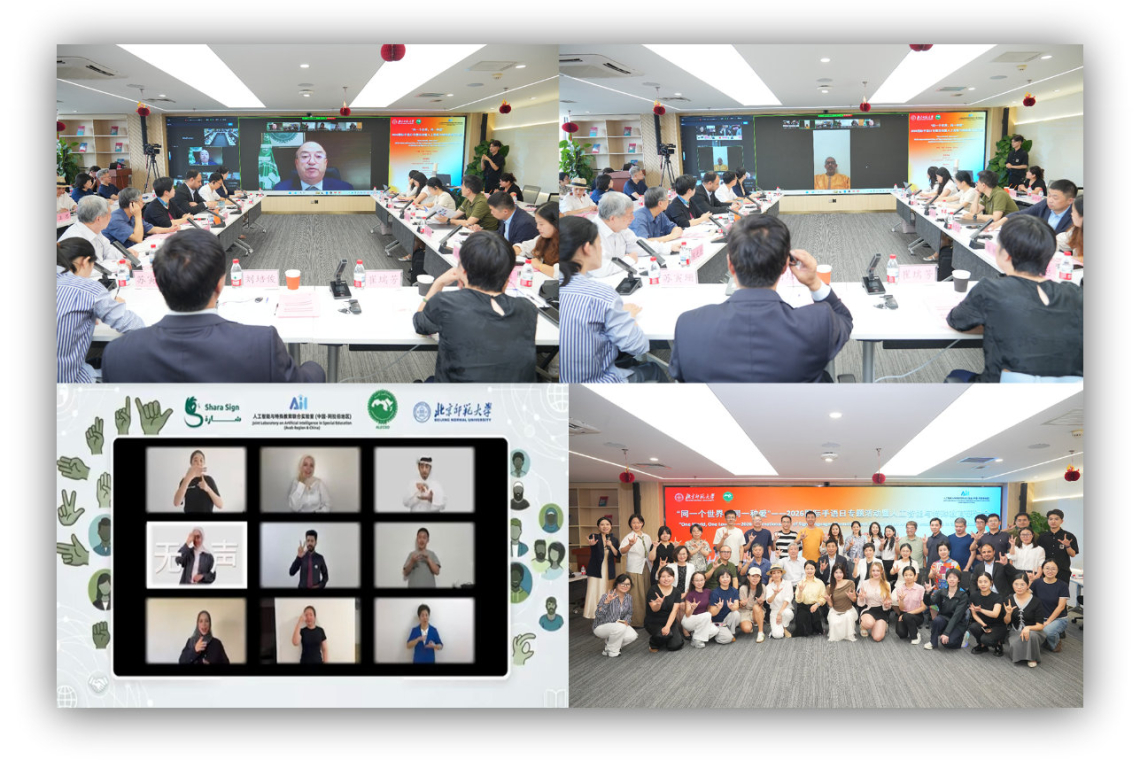
The Arab League Educational, Cultural and Scientific Organization (ALECSO) participated, on 23 September 2026, in the international event “One World, One Love,” held to mark the International Day of Sign Languages, alongside a symposium on artificial intelligence in the service of special education.
The event was organized in partnership with Beijing Normal University, the UNESCO Chair on Artificial Intelligence in Education, and the China–Arab AI Special Education Joint Laboratory, with the participation of a number of institutions, experts, researchers, and representatives of deaf communities from China, the Arab region, and Southeast Asia.
In his opening address, delivered remotely, H.E. Dr. Mohamed Ould Amar, Director-General of ALECSO, stressed that sign languages are not merely tools for communication, but living languages that embody identity, culture, and knowledge, and constitute an integral part of humanity’s linguistic and cultural diversity. He also emphasized that empowering persons with disabilities and ensuring their right to education and equal participation are fundamental to ALECSO’s mission and commitments in the Arab region.
The Director-General highlighted the importance of using technology and artificial intelligence to remove barriers and expand access to knowledge, provided that these technologies are inclusive, equitable, ethical, and accessible to all. He stressed that “the goal is not technology, but the human being.”
He took this opportunity to reaffirm ALECSO’s commitment to continuing cooperation with Arab countries and international partners to build more inclusive societies, more equitable education systems, and more human-centered technology. He called for sign languages to serve as bridges between peoples and for artificial intelligence to be used as a tool for promoting dignity and equal opportunities.
Launch of the Global Sign Languages Video
The event subsequently witnessed the official launch of the global sign languages video entitled “One World, One Love,” carrying the universal humanitarian message: “Different Languages, Shared Humanity.”
Dr. Mohamed Jemni, Director of ICT at ALECSO, presented the video and introduced its objectives and the participants involved in its preparation. He stressed that the initiative brought together people from different countries, cultures, and communities around the shared values of inclusion, communication, and human solidarity.
He indicated that the initiative received 25 video submissions from 12 Arab countries, of which 21 were selected for inclusion in the final version of the video. The Arab contributions represented six different sign languages, which, together with Chinese Sign Language, brought the project to a total of seven sign languages in a shared global production. The initiative also included nine contributions from China, representing a number of Chinese cities and provinces.
Dr. Jemni expressed his appreciation to all the deaf participants whose contributions gave the video its credibility and humanitarian spirit. He extended special thanks to Dr. Samir Samreen for his significant contribution to disseminating the call for participation and engaging with deaf communities across the Arab region, which helped achieve broad and diverse Arab participation.
Symposium on AI and Special Education
The scientific component of the event focused on exploring the potential of artificial intelligence and digital technologies to support special education and inclusive education.
The program featured a series of academic presentations addressing the relationship between artificial intelligence, special education, and inclusive education, as well as the future of sign-language technologies as they evolve from sign recognition toward understanding meaning and carrying out actions, and ultimately toward agentic artificial intelligence.
The DeafSafe project was also presented, using virtual characters and gamification techniques to promote safety among deaf people. The program additionally showcased innovative technological models and solutions in the areas of digital accessibility, communication, and education.
The event concluded with a roundtable discussion on the opportunities and challenges of artificial intelligence in the education of deaf people. Discussions addressed the transformations brought about by AI in education, entrepreneurship among deaf people, the development of accessibility products from a user-centered perspective, the rights of persons with disabilities, and the ethical dimensions of AI use.
ALECSO’s participation in this event forms part of its ongoing efforts to support inclusive education, promote linguistic and cultural diversity, and strengthen Arab and international cooperation in the use of artificial intelligence and emerging technologies to serve persons with disabilities, ensuring their full and effective participation in shaping the future.