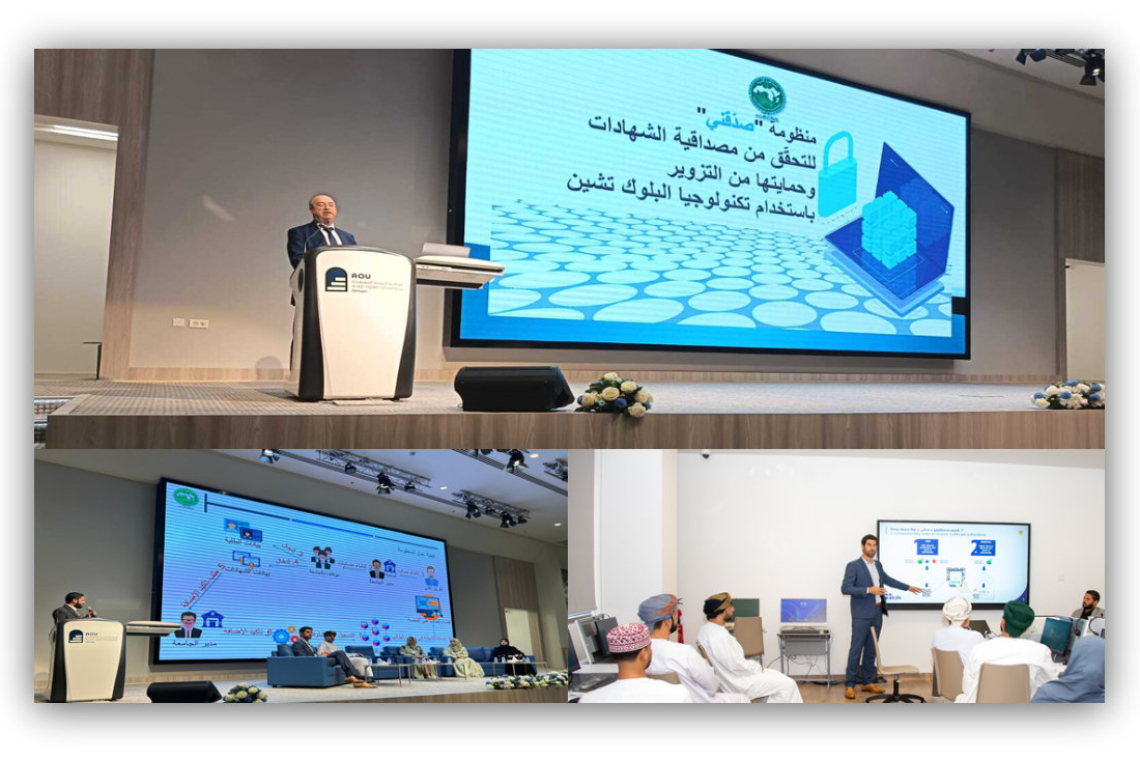
The Arab League Educational, Cultural and Scientific Organization (ICT Department), organized, in collaboration with the Omani National Commission for Education, Culture and Science and the Arab Open University, a regional workshop entitled “Using Blockchain to Verify Academic Certificate Authenticity and Prevent Forgery.”
The workshop was held in Muscat on October 7–8, 2026, under the patronage of H.E. Eng. Omar bin Hamdan Al Ismaili, Executive President of the Telecommunications Regulatory Authority of the Sultanate of Oman.
The workshop aimed to introduce Blockchain technology, its fundamental principles, and its applications in the education sector; present the Unified Arab System for Blockchain-Based Certificate Authentication; explore ways for the Sultanate of Oman to join the System; and strengthen the technical capacities of universities and educational institutions in digitally documenting and verifying academic certificates and qualifications.
Addressing the workshop, Dr. Mohamed Jemni, Director of ICT, conveyed the greetings of H.E. Dr. Mohamed Ould Amar, Director-General of ALECSO, along with his wishes for the success of the event.
On the first day, Dr. Jemni delivered two lectures. The first presented ALECSO’s projects and initiatives in artificial intelligence and digital transformation in education. It highlighted the Organization’s efforts to support Arab countries in developing relevant policies, frameworks, and strategies, building capacities, promoting research and innovation, and harnessing modern technologies to advance educational systems and institutions.
The second lecture focused on Blockchain technology, its fundamental principles, and its applications in education. Dr. Jemni explained the technical concepts essential to understanding this technology, including blocks and distributed chains, decentralization, cryptography, digital fingerprints (hashes), and verification mechanisms that ensure data integrity and prevent tampering. He also outlined the key characteristics that make Blockchain a promising technology for building digital trust and protecting records and documents.
The lecture also explored educational applications of Blockchain beyond certificate authentication, including its potential use in managing academic records, documenting skills and qualifications, supporting lifelong learning, and verifying educational data and transactions. Particular attention was given to the potential synergies between Blockchain and AI in developing more reliable and secure digital education systems.
The workshop also addressed ALECSO’s Unified Arab System for Blockchain-Based Certificate Authentication, which is currently being developed to provide a standardized Arab mechanism for the digital verification of academic qualifications and certificates. The system aims to combat certificate forgery, strengthen trust in academic records, and facilitate verification processes among educational institutions that rely on these credentials.
The workshop featured scientific sessions covering several related themes, including the use of Blockchain in education, educational data governance and Cybersecurity, certificate authentication and protection against forgery, and digital transformation projects and educational quality. The sessions also introduced the services offered by the Unified Arab System and the mechanisms for implementing it within educational institutions.
The workshop was particularly significant in light of the Sultanate of Oman’s ongoing efforts and projects in digital transformation and the adoption of modern technologies. It provided an opportunity to share expertise, learn about ALECSO’s experience and Arab initiatives in this field, and explore prospects for cooperation and the potential benefits of Blockchain-based solutions in developing digital educational services.
The workshop brought together officials, university presidents, deans, academics, experts, and researchers from public and private universities and colleges across the Sultanate of Oman, alongside specialists in digital transformation and educational quality assurance. Their participation facilitated the exchange of experiences and best practices in using emerging technologies to advance education systems and enable the digital verification of academic qualifications.
The second day of the workshop was devoted to practical training. Participants were introduced to the mechanisms for using the “Saddiqni” system, as well as the stages involved in digitizing certificates and registering them in the system. These activities were designed to strengthen the technical capacities of educational institutions and enable them to benefit from modern digital solutions for documenting qualifications and verifying their authenticity.
This workshop forms part of ALECSO’s broader efforts to support Arab countries in their digital transformation, promote the responsible and secure use of emerging technologies in education, and develop joint Arab technological solutions that strengthen trust in academic certificates and qualifications.