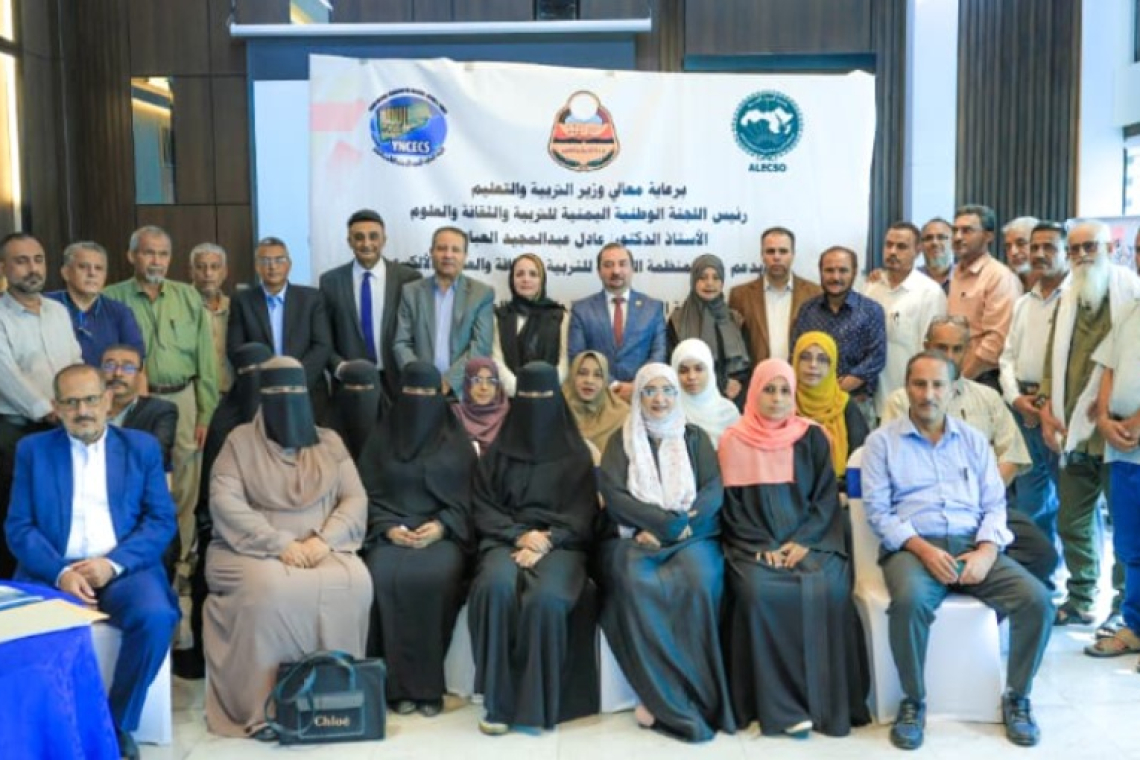
The Arab League Educational, Cultural and Scientific Organization (Education Department) held a training programme in collaboration with the Yemeni National Commission for Education, Culture and Science. The programme comprised two specialized workshops on strategic planning and crisis management in general education, and digital transformation through curriculum digitization and the integration of artificial intelligence.
The programme took place in Aden, Yemen, from 11 to 13 October 2026, under the patronage of H.E. Dr. Mohamed Ould Amar, Director-General of ALECSO, and H.E. Dr. Adel Abdulmajeed Al-Abbadi, Minister of Education and President of the Yemeni National Commission for Education, Culture and Science.
In his opening remarks, Dr. Rami Iskander, Director of Education, conveyed the Director-General’s greetings and best wishes for the success of the workshops. He stressed the importance of strengthening the capacities of leaders and specialists in general education, improving strategic planning and crisis management practices, keeping pace with digital transformations, and harnessing AI applications to develop curricula and educational resources. He noted that developing education systems requires combining proactive planning and institutional preparedness with the thoughtful use of technology in education. He also highlighted the need to consider national priorities and available resources while ensuring that digital initiatives are aligned with clear educational objectives that contribute to improving education quality and learning outcomes.
The programme is designed to develop participants’ professional skills in two interconnected areas that contribute to improving educational performance. The first workshop, entitled “Strengthening Strategic Planning and Crisis Management Skills for Leaders and Specialists in General Education,” focuses on anticipating and analyzing risks, setting priorities, developing scenarios, and establishing response and recovery mechanisms. It also addresses the need to link strategic plans to implementation measures and performance indicators, thereby enhancing institutional preparedness and supporting the continuity of the educational process under exceptional circumstances.
The second workshop, entitled “Digital Transformation: Digitizing Curricula and Integrating Artificial Intelligence,” aims to strengthen participants’ capacities to design digital curricula, produce and develop educational resources using AI applications, and explore the potential of these technologies to improve teaching, learning, and assessment processes. It also addresses the importance of verifying the accuracy and quality of content, taking Arabic linguistic and cultural specificities into account, and ensuring the responsible use of technology in support of educational objectives.
This programme is part of ALECSO’s efforts to support the national initiatives of countries facing crises and exceptional circumstances in the field of education. It also aligns with Yemen’s education development priorities, including the directions set out in the National Education Sector Plan 2024–2030 regarding the improvement of educational performance and capacity-building for leaders and specialists.
The programme also recognizes the importance of developing digital educational solutions suited to existing infrastructure, connectivity, and available resources, while promoting digital equity and expanding access to educational resources. It further emphasizes the value of drawing on Arab and international expertise and adapting it to national needs, thereby supporting the development of practical and sustainable educational approaches.
This programme forms part of ALECSO’s broader efforts to strengthen educational cooperation among its Member States, build national capacities, and facilitate the exchange of expertise in developing educational policies and practices; thereby contributing to improving the quality of education and enhancing its responsiveness to current transformations and challenges.