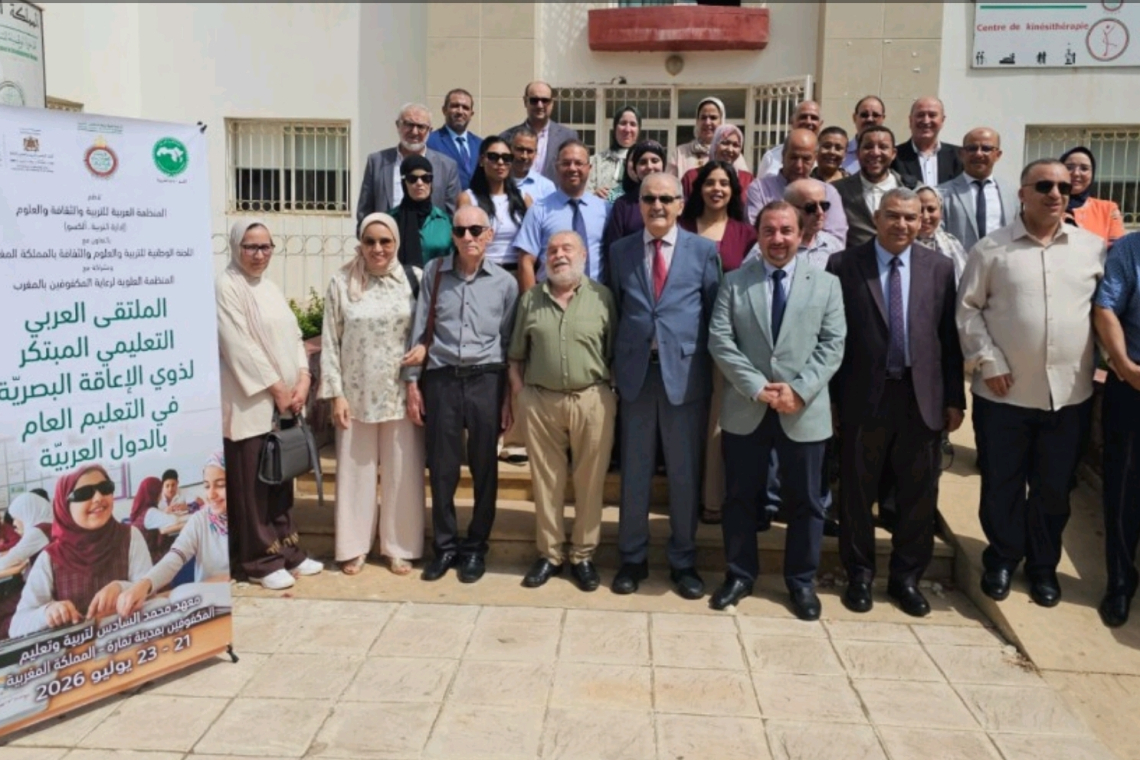
The “Arab Innovative Educational Forum for the Visually Impaired in General Education in the Arab States” took place in the city of Temara, Morocco, on July 21-23 2026. The Forum was organized by ALECSO, in collaboration with Alaouite Organization for the Welfare of the Blind and the Moroccan National Commission for Education, Science and Culture, with the participation of prominent experts and specialists from across the Arab region.
The Forum is part of ALECSO's ongoing efforts to advance inclusive education throughout the Arab world, by developing a modern Arab vision for the education of blind and visually impaired persons. This vision is based on the latest educational practices and seeks to promote the use of assistive technologies and AI applications to ensure educational equity and improve learning opportunities for all.
In his opening remarks, Dr. Rami Iskander, Director of Education, conveyed the greetings of H.E. Dr. Mohamed Ould Amar, Director-General of ALECSO, to all participants, and his best wishes for the success of the Forum. He stressed that inclusive education and the empowerment of persons with disabilities are among ALECSO's key strategic priorities.
Dr. Iskander noted that digital transformation and artificial intelligence are now essential tools for creating more inclusive and equitable education systems. He emphasized the importance of harnessing modern assistive technologies to enable learners with visual disabilities to study independently within educational environments that accommodate their needs and offer them equal learning opportunities. He commended, in this regard, Morocco's progressive vision in advancing inclusive education. He highlighted the efforts invested by the Ministry of National Education, Preschool and Sports in promoting the rights of persons with visual disabilities, through updated educational policies, human resource development, and the expanded use of assistive technologies and artificial intelligence in education. He described Morocco's experience as one of the leading Arab models worthy of recognition and wider adoption.
Dr. Iskander indicated that the Forum aims to develop a reference Arab framework for improving education for persons with visual disabilities, designing teacher-training programs, and producing accessible digital educational resources. It seeks to come out with practical recommendations to support educational policies across Arab countries while keeping pace with global developments in inclusive education.
Over the course of three days, the Forum featured scientific sessions and specialized workshops addressing the development of inclusive education across all educational stages, AI applications and assistive technologies, teacher preparation, and the production of accessible digital content. Relevant Arab experiences were showcased during the Forum.
At the conclusion of the opening session, ALECSO's Education Department expressed its sincere appreciation to the participating experts whose scientific contributions enriched the Forum. Special recognition was given to Dr. Walid Zidi, former Minister of Cultural Affairs of Tunisia and Expert at ALECSO’s Education Department, for his scientific supervision and coordination of the Forum. Appreciation was also extended to Dr. Hamada Ali Abdel Moati of Egypt and Dr. Abderrazzak Boughanbour of Morocco for their distinguished academic expertise and specialized insights, which significantly contributed to the success of the event and the quality of its outcomes.
The Forum concluded with the adoption of a set of practical recommendations and the launch of the Arab Reference Framework for the Development of Education for Blind and Visually Impaired Learners. These outcomes aim to support Arab countries in building more inclusive and sustainable education systems while promoting innovation and the responsible use of artificial intelligence in inclusive education.