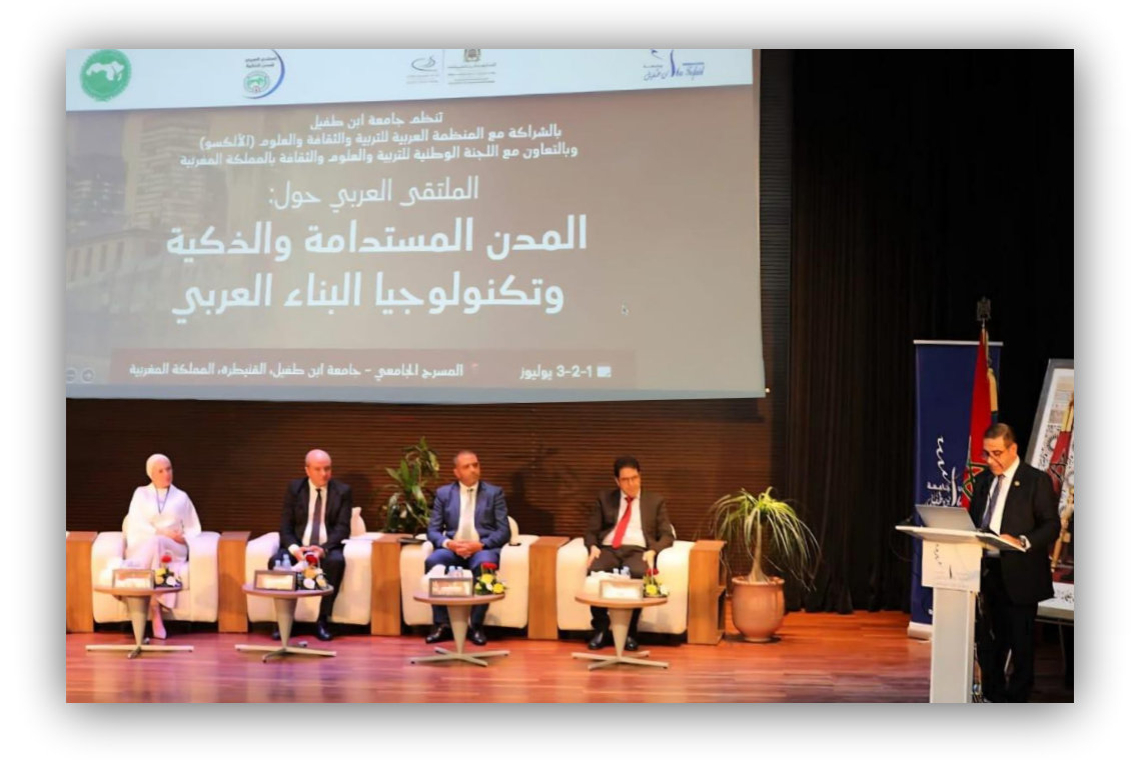
Under the High Patronage of His Majesty King Mohammed VI, and under the supervision of His Excellency Dr. Mohamed Ould Amar, Director-General of ALECSO, the Arab Forum on "Smart and Sustainable Cities and Arab Building Technology" was held from 1 to 3 July 2026 at Ibn Tofail University in Morocco. The Forum was organized by ALECSO's Department of Science and Scientific Research jointly with Ibn Tofail University, the Moroccan National Commission for Education, Science and Culture, and the Arab Smart Cities Forum.
The opening session was attended by representatives of Moroccan government institutions, along with prominent experts from across the Arab world specializing in architecture, urban planning, urban development, digital transformation, and systems analysis. The event also attracted a large number of students and researchers.
In his opening remarks, Dr. Mohamed Sanad Abu Darwish, Director of Science and Scientific Research at ALECSO, emphasized that the Forum was organized in pursuit of the objectives of the Arab Strategy for Scientific Research, Technology and Innovation, as well as the United Nations Sustainable Development Goals (SDGs). Through this event, the Organization aims to strengthen Arab capacities in the planning and development of smart and sustainable cities, while also highlighting modern concepts and approaches related to sustainable urban development. He added that the Forum seeks to contribute to the formulation of policies and strategies designed to promote sustainable, safe, and environmentally friendly cities through the application of Arab building technology. Furthermore, it serves as a platform for sharing expertise among Arab countries and enhancing the capacities of young professionals in engineering and technology, enabling them to design smart and sustainable Arab cities that meet the aspirations and needs of future generations.
Through scientific presentations, panel discussions, and interactive workshops, the Forum explored the role of smart buildings in advancing sustainability, the mechanisms for integrating energy efficiency and resource conservation with local environmental requirements, and the opportunities for incorporating modern technologies and Arab building techniques into the future development of smart and sustainable Arab cities. The sessions also highlighted the distinctive features of Arab architectural traditions and their contribution to sustainable construction and environmental preservation.
The Forum concluded with several key recommendations, particularly the need to update specialized architectural and urban planning curricula in Arab universities to empower young professionals to lead this transformation. Participants also recommended developing a unified reference framework and establishing a Unified Arab Smart City Code to serve as a common guideline across the region.
During the Forum, several memoranda of understanding (MoUs) were signed between the participating Arab engineering faculties and Ibn Tofail University to promote cooperation in teaching, training, scientific research, and the exchange of expertise in the fields of smart and sustainable cities, architecture, and Arab building technology.