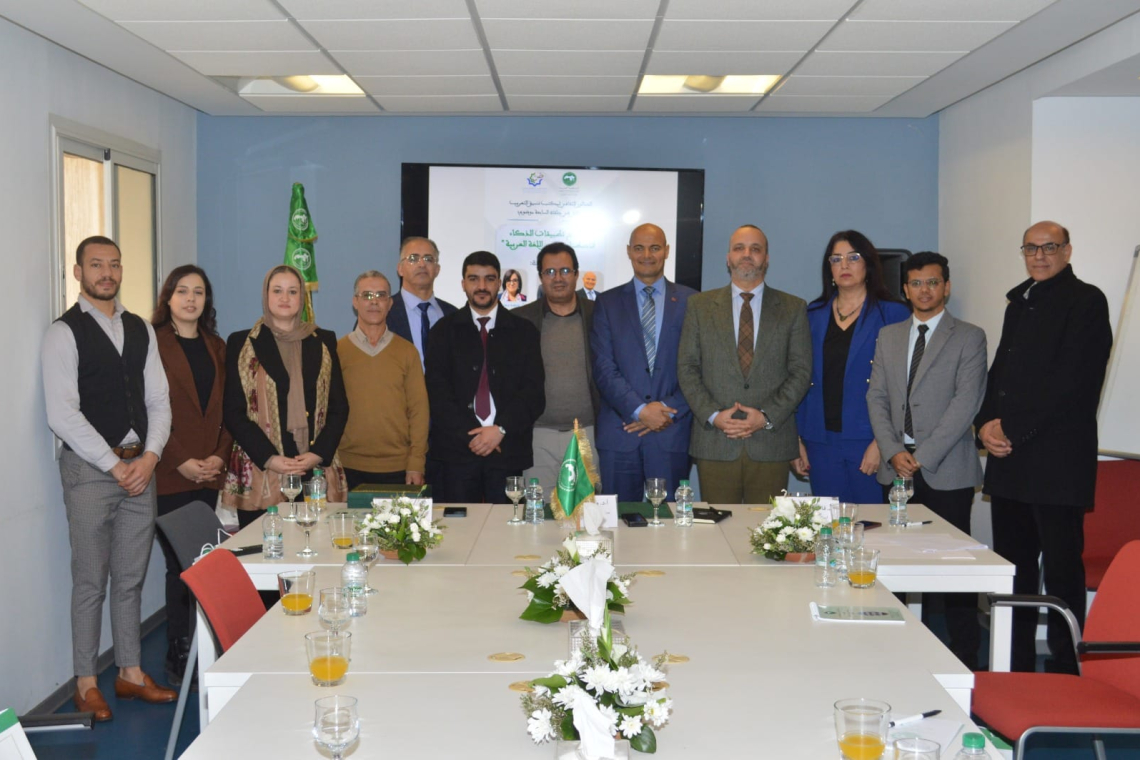
As part of its ongoing cultural and scientific initiatives to foster knowledge exchange and keep pace with digital transformation, the Arabization Coordination Bureau, a subsidiary institution of ALECSO, organized, on February 19, 2026, the 7th session of its Cultural Salon under the title: “Integrating AI Applications into the Arabic Language.” The event brought together prominent researchers and specialists in Arabic language studies and modern technologies.
In his opening remarks, Dr. Mourad Rifi, Director of the Arabization Coordination Bureau, emphasized the importance of keeping pace with rapid digital change and harnessing AI technologies to serve the Arabic language. He stressed the need to reinforce its active presence in both digital and educational spheres, thereby contributing to the advancement of linguistic research and the modernization of its tools.
The Salon hosted Dr. Youssef Attia, Senior Lecturer in Arabic Language at Indiana University, who began his presentation by expressing gratitude to the Arabization Coordination Bureau and to all attendees for organizing this scientific event, which provides valuable opportunities for exchanging expertise and fostering academic dialogue.
Dr. Attia reviewed the latest AI-supported educational tools, emphasizing that the future of the Arabic language in the digital age is not tied solely to the use of these technologies; it also requires strengthening the presence of Arabic within language models through proper use and by feeding them with accurate linguistic input. He noted that large language models fundamentally depend on user-provided data, and that every proper use of Arabic contributes to improving these systems’ performance and enhancing their ability to process the language more effectively. He also stressed that artificial intelligence cannot replace the teacher, given the deep cultural and human dimensions embedded in language that can only be conveyed through human interaction. He underlined that these technologies are designed to enhance the educational process, not to replace the indispensable human element.
The Cultural Salon of the Arabization Coordination Bureau serves as a periodic academic platform for dialogue on issues related to Arabization, terminology, and lexicography. It supports ongoing efforts to develop the Arabic language and strengthen its presence across diverse scientific and technological domains.
The Salon sessions will be made available through the Bureau’s platforms and websites.